

Alumna bridging development and climate action through climate finance
Posted: 5 June 2026
Aditi Pathak is an Indian Economic Service officer serving as Joint Director in the Ministry of Finance, Government of India. With more than a decade of experience in public policy, economic analysis, and international negotiations, she currently works in the Climate Change Finance Unit, focusing on strategies to mobilise finance for climate resilience and sustainable development.
In September 2025, she completed the Australia Awards Regional Short Course on Accessing Climate Finance, delivered by Griffith University. The course brought together 21 participants from Bangladesh, Bhutan, India, Maldives, Mongolia, Nepal, Pakistan, and Sri Lanka, who travelled to Brisbane, Canberra, and Sydney.
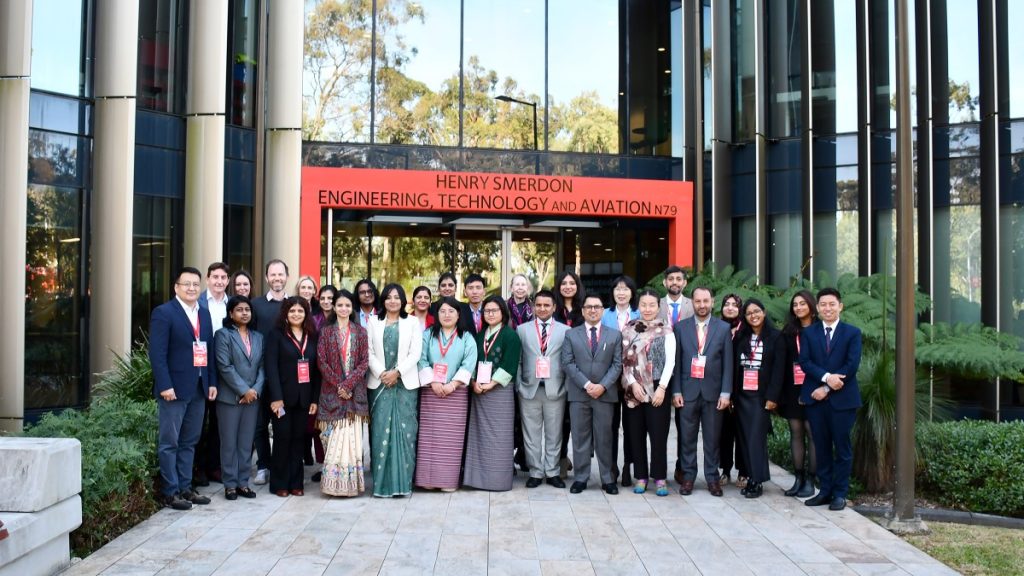
Aditi (front row, fourth from left) pictured with other Short Course participants at Griffith University in Australia. Photo courtesy: Griffith University.
Aditi’s professional journey reflects a strong commitment to integrating development priorities with climate action. In her current role, she works at the intersection of policy, finance, and international cooperation, contributing to initiatives that strengthen economic and environmental resilience. Her role involves engaging in climate finance policy, assessing projects and initiatives backed by multilateral organisations, such as the World Bank and various international financial institutions. She has represented India in various international forums, including the United Nations Framework Convention on Climate Change (UNFCCC), G20, and BRICS, aiding in the advancement of India’s climate finance taxonomy development. Through these engagements, she contributes to aligning economic priorities for India with its climate commitments by enabling informed policymaking, strengthening global partnerships, and facilitating access to financial resources essential for low-carbon growth and long-term sustainable development.
Her contributions to the climate change sector span several major global platforms and international engagements. She contributed to shaping India’s position in the 9th replenishment discussions of the Global Environment Facility, with a focus on equitable access to climate finance. She also participated in the 2025 Sharm el-Sheikh Dialogue, a series of workshops mandated under the Paris Agreement and held in Rome, where she supported negotiations aligned with India’s national priorities and developmental interests. Additionally, she has contributed to discussions related to the Global Plastics Treaty, engaged in climate-related deliberations under BRICS, and the G20 Sustainable Finance Working Group (SFWG).
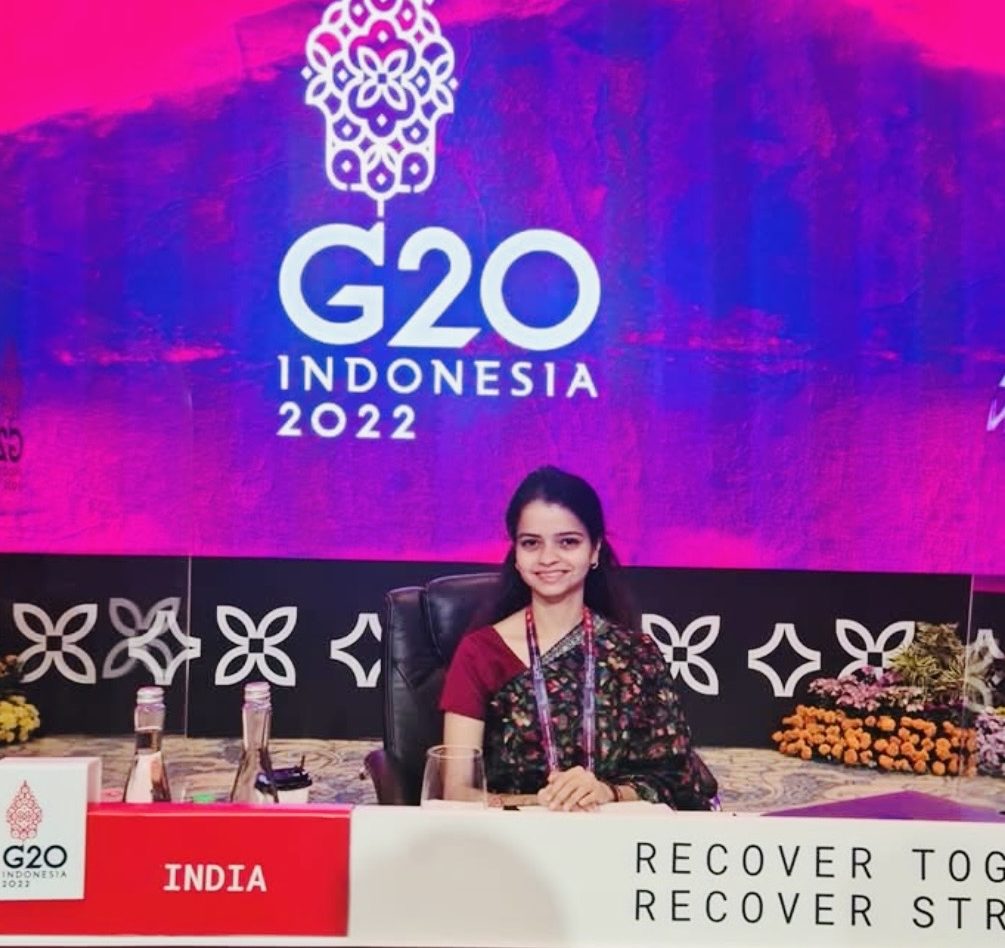
Aditi pictured at the G20 Summit.
Reflecting on her Short Course experience, Aditi highlighted the importance of integrating climate action with broader development objectives. She noted that, in countries like India, climate policies must align with priorities including economic growth, infrastructure development, poverty reduction, and social protection. She observed that investments in healthcare, education, and resilient infrastructure are also critical to strengthen climate adaptation capacity. At the same time, she acknowledged that the ongoing challenges in scaling climate-resilient finance remain challenging. Developing countries continue to face barriers in accessing affordable and adequate international climate finance despite support from institutions such as the Global Environment Facility, Green Climate Fund, and multilateral development banks. She also pointed the impact of global risk-assessment frameworks, which often classify developing economies as high-risk, increasing borrowing costs, and limiting access to long-term capital. Adaptation initiatives, including flood protection and resilient agriculture, also struggle to attract private investment due to limited direct financial returns. Addressing these gaps requires stronger public support, blended finance mechanisms, and enhanced institutional capacity at national and sub-national levels.
She said, “The Short Course has significantly strengthened my professional capacity by deepening my understanding of global climate finance architecture, innovative funding instruments, and best practices in mobilising resources for climate action. It provided valuable exposure to international perspectives, practical tools, and case studies that I now apply in my work on climate finance policy and negotiations.”
She also mentioned that the course enhanced her ability to engage more effectively in multilateral discussions and strengthened her analytical approach toward designing financing strategies. In terms of linkages, she says, she continues to benefit from the professional network built during the program, engaging with peers and experts from Australia and other countries through knowledge exchange and collaboration in international forums related to climate finance and sustainable development.

Aditi (left) participating in the Short Course in Australia. Photo courtesy: Griffith University.
Speaking of this year’s World Environment Day theme, Aditi says that “A global call for climate action” in the workplace means embedding climate priorities into core economic and financial policymaking. It involves aligning fiscal strategies, public investments, and financial systems with sustainability goals, while strengthening international cooperation to mobilise adequate climate finance. It also reflects the need for coordinated action across ministries and institutions to ensure that development pathways are climate-resilient and low-carbon. At the community level, she describes climate action as a shared responsibility that requires encouraging sustainable practices, raising awareness, and enabling local institutions to act effectively. It emphasises that climate action is not limited to global negotiations but must translate into practical and inclusive outcomes at national and local levels through coordinated efforts and long-term commitment.
Aditi has also contributed to several significant international engagements, including India’s G20 Presidency in 2023 and BRICS India Presidency in 2021, supporting policy coordination and global economic discussions. In 2022, she was selected to represent India at the G20 Global Leadership Programme conducted at the KDI School of Public Policy in the Republic of Korea. Additionally, her research work received national recognition with a second-place award in the National Institution for Transforming India (NITI) Aayog National Data and Analytics Platform competition to recognise excellence in data-driven analysis and its application to policymaking.
Further referring to this year’s World Environment Day theme, Aditi says, “We must act responsibly toward climate action as our duty, without waiting for immediate benefits.”